Tuesday, November 3, 2009

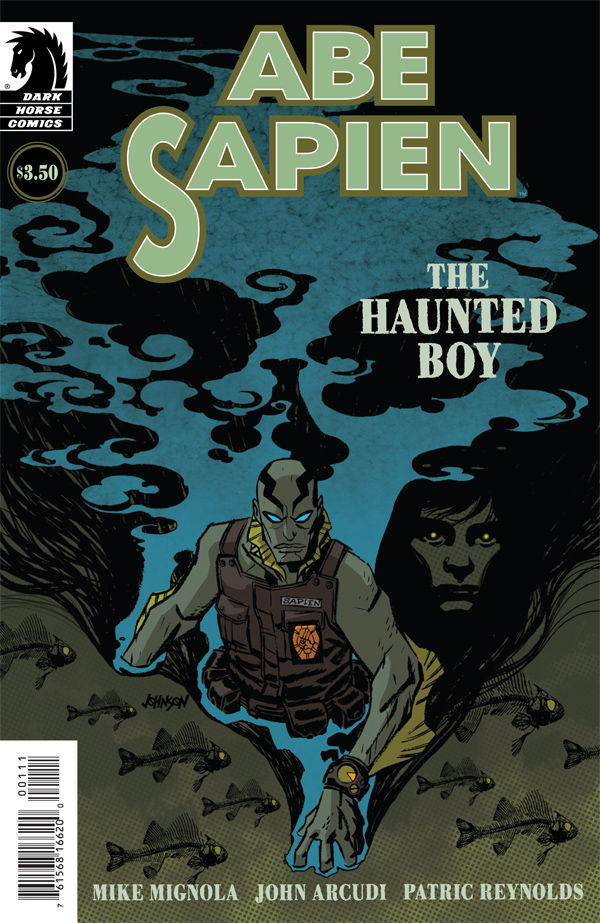
Abe Sapien: The Haunted Boy


Written by Mike Mignola and John Arcudi. Art by Patric Reynolds. Colors by Dave Stewart.
Abe Sapien: The Haunted Boy is a stand-alone story in a series of one-shot issues which Dark Horse is releasing over the coming months. BPRD's famed green hero investigates a haunting following the drowning of a teenage boy, deals with grieving relatives and a sullen witness, and ends up confronting yet another monster taken from European mythology, this time a Scandinavian one.


The artwork of relative newcomer Patric Reynolds is solid, and he does a great job at finely characterising his protagonists through gestures and facial expressions. Abe comes across as more athletic and dynamic than in other BPRD titles. I especially like Reynolds' take on the monster. Which leads me to the criticism I have of the book: the story ends too fast. The set-up is nicely done, but the solution is hurried:  the final confrontation with the monster is all too brief, relies on a coincidence to solve the issue and thus comes across as a bit of an anti-climax. Which is too bad. I guess sometimes it does take more than 24 pages to tell a story well.
Rating: 3.5 out of 5.

Sunday, November 1, 2009

Detective Comics #858 / Batman #692

Batwoman in Detective Comics #858: Writer: Greg Rucka. Artist: J.H. Williams III. Colours: Dave Stewart.
The fifth issue of Detective Comics featuring Batwoman proves again that this is the real gem among the new or revamped Bat titles currently pushed on the market by DC Comics. In the first part of an origin story, with flashbacks relating the childhood and early adolescence of Kate Kane and her twin sister, the art team again shows itself in peak form, alternating again between different art styles to get the story across: an old-fashioned looking, classic, well-ordered comic look for the flashbacks, and the contrasting, dynamic layout driven by a sombre colour palette offset by the bright reds associated with the Batwoman character. One simply brilliant page even relies on on nothing but text snippets to tell an episode. All in all, one of the best superhero titles out there. 
Rating: 5 of 5.


Batman #692: Written and Drawn by Tony S. Daniel. Inks: Sandu Florea. Colors: Ian Hannin.

With the arrival of Tony S. Daniel as writer/artist, the Batman title finally rises up from the mediocrity of the past few weeks. Daniel's stylish graphics (at times resorting to a classic film noir look) and the first convincing representation of Dick Grayson as Batman (all angles and shadows) make this series again worth its money.
The plot: Dick Grayson/Batman enlists the help of Catwoman to find the layer of Black Mask, and instead gets sent into the hands of the Falcone mob, while Catwoman pursues her own schemes. Black Mask meanwhile digs up even more villains to serve him.
The title's overall plotting is still its weal point. While Black Mask 'wins' over more and more of the Bat-verse's renowned villains to his side, Batman gets side-tracked again and again in his search for Black Mask. You'd think the title would start building up momentum leading to the final confrontation between the two, but instead there is the usual villain-of-the-week plotting, which probably means that the showdown will end up being rushed over a couple of titles a few weeks down the line.
Rating: 3.5 of 5.

Saturday, October 31, 2009

Clive Barker's Seduth

Writers: Clive Barker and Chris Monfette. Art by Gabriel Rodriguez, colors by Jay Fotos, 3D conversion by Ray Zone. Published by IDW.

With the slew of 3D movies invading the cinemas, it is no small wonder that 3D is making its return to comics. To tell the truth, I have never read a comic where I felt that 3D added anything to it, often quite the contrary; so I assumed that 3D was in the case of this book nothing more than a neglect-able gimmick.


Not so: the whole comic has been built around 3D, and it probably wouldn't work without it. It's also the best 3D graphic I've ever seen - it works, and it makes sense in the term of the imagery used here.


As to the story line: this is a rather short, surreal tale about the nature of creation and destruction - or nihilism. As Clive Barker's notes at the end of the book suggest, its inspiration comes from the works of surrealists Bunuel or Fellini. There is no real linear plot in the usual sense, more a series of images, as disconnected as can be when taken from visions or nightmares - using horror elements without being a horror comic. The story line can be viewed as an exercise in style; and even though the book purports to be about themes such as creation or existence, there is really no new message here - only some vague notions transported by a narrative swelled with pathos. One is left with the feeling that there is a bit too much ado about nothing - or at least, about very little of substance. Maybe 24 pages weren't enough to fully develop what Clive Barker had in mind. But maybe this is also just a book that was meant to be judged on its visual qualities alone. And as such, it works Certainly, the 3D art is worth the money alone.


Rating: 3.5 out of 5.

Friday, October 30, 2009

Batman Unseen #2

Writer: Doug Moench. Art: Kelley Jones. Colours: Michelle Madsen.

Doug Moench's and Kelley Jone's run with the regular Batman title used to be a highlight for me. So I'm glad to see them back on a Bat title, and to witness the return of the foot-long ears, the yellow bat sign and the impossibly huge cape. Batman Unseen delivers all that in Jones' inimitable style and Moench's tongue-in-cheeck story-line about a mad scientist who turns himself invisible layer by layer, Batman who ponders his own apparent lack of scariness, due to too much invisibility while the Black Mask is hovering in the wings. All in all, this promises to be a great miniseries.

Wednesday, October 21, 2009

Batman and Robin #5

Writer: Grant Morrison. Art: Philip Tan, Jonathan Glapion, Alex Sinclair.

Having moved from the weird to the more mainstream, Batman and Robin's decidedly dark take on the Dynamic Duo continues to excel. Batman and Robin are pitched against the the two murderous vigilantes: Red Hood, whose identity is surprisingly revealed early on, and the rather scary Scarlet; and, as the laws of comics demand, our heroes are currently losing out to the two villains who are but distorted mirror images of the new Batman and the new Robin. Mysterious Oberon Sexton also puts in another appearance, being set up as maybe an important figure to come; while yet another new villain, the blood-thirsty Flamingo, reaches Gotham.

The plotting slows down a bit in this issue, setting up the players for the next act. The art is still dark and rather outstanding. All in all a very good read.

Rating: 4 out of 5.

Batman #691

Writer: Judd Winick. Art: Mark Bagley, Rob Hunter. Colours: Pete Pantazis.

While DC Comics continue to provide quality comics with the recent Batman spin-off titles, it is amazing that the Batman title itself is allowed to run it's rather mediocre run. The writing is not at fault: while not at its most original, it nonetheless moves along nicely Dick's struggles as the new Caped Crusader and the intrigues of the Black Mask. The issue opens with Batman facing Two-Face inside the Batcave itself and ending up having his butt saved by Albert. Dick / batman is portrayed here as a man who still makes mistakes but attempts to learn from them. At the end, Dick breaks with one more piece of Bruce's past by clearing the batcave, and ends up finding an intriguing link to his own past.

Black Mask, meanwhile, lays his grubby hands on Two-Face, and the next issue will reveal if Harvey throws in his lot with old skeleton head.

The title's weak spot continues to be the art. It's better than it has been but is still below average. The colours are less garish than they were in the last issues, but still rely a lot on awful Photoshop effects. Next issue will see writer / artist Tony Daniel take over the title, which can only profit from this change.

Rating: 2 of 5.

Sunday, October 18, 2009

Red Robin #5

Written by Chris Yost ; Art by Ramon Bachs.

I'm not a great fan of teenage sidekick comics, and I picked up Red Robin only because it promised to lead to the mystery surrounding the fate of recently vanished Bruce Wayne. The series started off with an epic, world-spanning romp involving an almost grown-up Tim Drake; and after the first two issues I decided to stay with the title. The series seems to be set out as a coming-of-age story for a character who has lost, within the span of a few years, his father, girl friend, adoptive father, and who has been recently deposed as Robin, and sends our newly brooding hero on a quest around the world to find out the whereabouts of that other brooding hero, Bruce Wayne. He soon becomes embroiled with Ra's al Ghul, also on the look-out for Bruce Wayne, and with the League of Assassins.

Issue #5 opens a new story arc which sees Tim saved by the League and agreeing to work with them to defeat their enemy, the Council of Spider. It sets up a new villain, the Wanderer, and establishes a potential love affair between Drake and one of the assassins, while also throwing one of Lucius Fox's attractive daughters into the mix.

Using a Lost-like time-hopping storytelling technique, writer Chris Yost keeps up the tension throughout. The art work is solid and adequate but not outstanding. The book has one big problem, 'though, and that is Red Robin's downright silly costume (daft even by comic book standards). Red Robin is a solid title with a promising, riveting story line.

Rating: 3.5 out of 5.

Hellboy: The Wild Hunt #7

When the eight-part story arc The Wild Hunt started, the editors were spreading the word that at the end of it, neither Hellboy nor the world would remain the same. Mike Mignola sends the reader on a wild roller-coaster ride through much of British folklore - past witches searching for a new queen, giants, the Daoine Sidhe and the Wild Hunt itself - straight into the mother of all British legends, the Arthurian saga. Both the witches' new queen and Hellboy's fate (and origin) are directly linked to people and events taken from the stories surrounding the mythical King Arthur. In issue 7, we (and Hellboy) are given titbits of the fate that supposedly awaits Big Red, and in the end he does indeed seem to be on the path leading to that destiny. As so often in Mignola's comics, visions and real events are intertwined in a complicated, dream-like sequence of events which leave much open to interpretation. And indeed, the Hellboy saga moves forward for the first time in many years.

Duncan Fegredo's art is fittingly dark and brooding, and he has now made the Hellboy character his own, drawing him with the same certainty as does Mignola himself. Dave Stewart's colors are as always top notch and so much an integral part of the Hellboy comics.

The backup story, by Mignola, Scott Allie and Patric Reynolds, tells of the a 17th century witch-hunter, Henry Hood (a character introduced in earlier Hellboy stories); a solid short story (as were the backup stories in the previous issues).

Issue #7 confirms The Wild Hunt as an imaginative, brilliantly rendered piece of storytelling; comics at their best.

Rating for the series: 5 of 5.

Sherlock Holmes: The Trial of Sherlock Holmes

Dynamite Entertainment's series Sherlock Holmes: The Trial of Sherlock Holmes, came to a close with the recent publication of issue 5. The story arc saw Sherlock Holmes caught in a locked room mystery with himself (being the only one on the premises) as the prime suspect of murdering a former high ranking policeman. Intertwined with Holmes' predicaments are assassination attempts on the life of a visiting German dignitary keeping Inspector Lestrade busy. The final issue sees Holmes, who has surrendered to the police in issue 4, in the docks, where he - obviously - solves the mystery for the jury and the readers alike. The very last page then reveals the link between Holmes' problems and the assassination attempts, in what turns out to be a plot within a plot worthy of Macchiavelli.

The five issue story arc makes for very good reading; the plot retains its suspense until the very end. The characterisation of the major personalities is very good, both in the writing and in the art. Aaron Campbell's art is detailed and moody, with a good feel for the period and the place, without resorting to too many stereotypes. There are a few blunders in the first issues, such as the East End being depicted as a suburb rather than the oppressive slum area that it was. The last issue features some impressive massive crowd scenes, and some well handled action scenes rendered in parallel to the court room proceedings.

A few blunders exist in the writing as well, such as some occasional dialogues using a really horrendous pseudo-period British English. The colours are overall solid and adequate, but resort a tad too much to highlighting, which gives the panels a 'plasticy' look.

Overall, a well done, very entertaining series. For those who missed the early issues, Dynamite Entertainment has already announced the publication of a hard cover edition.

Rating: 4 out of 5.

Tuesday, October 6, 2009

Sir Edward Grey, Witchfinder: In the Service of Angels

Dark Horse's latest Hellboy spin-off is nearing completion, so this seems a good time to review Mike Mignola's latest comics outing. The setting is Victorian London and the hero is one Sir Edward Grey, a character who has had guest appearances in a couple of Hellboy and BPRD stories. The mystery begins with a grisly murder whose victim was a member of an archeological expedition to the Sahara who has discovered the remnants of a Hyperborean city. Later, all the members of the team are picked off one by one by a demon-like creature that the team has inadvertedly brought back with them to London.

The story then continues with Grey's search for the monster which grows more powerful with each killing. Along the way we are treated to a collection of colourful characters, such as a 200-year old Captain lifted from Gulliver's Travels; and a mix of fantastic 19th century myths, such as the Hollow Earth theory which becomes linked to the Hyperborea myth. There are also tie-ins with current BPRD storylines, most notably the grisly frogs which have been at the centre of recent BRP story arcs, as well as the Helioptic Brotherhood of Ra. The latest issue, number 4, introduces Martin Gylfrid, the character at the centre of the recent BPRD storylines.

The story is vintage Mignola then, full of mysteries drawn from all sorts of legends and period literature. The plotting is impeccable, as is Ben Stenbeck's art. In rather simple lines, Stenbeck draws a very moody, very believable Victorian London. Smog-filled streets, overstuffed drawing rooms, a truly menacing East End - highly stereotypical maybe, but well rendered and required to set the scene for readers who know the time period chiefly through movies.

My one regret about the title so far is that the main charctet remains decidedly one-dimensional. We learn about his past exploits, which include saving the queen from witches, earning him the knighthood; we are told that he is in the service of angels and that a dire fate may befall him. But very little of his character is revealed, apart from his penchant for quoting the bible when faced with otherworldly creatures. Unlike other examples of Mignola's creations, this one has no foibles, no character quirks to make him memorable. Not yet, at least. There is a budding romance between Grey and Mary, the medium, which may serve to show a more personal side of him; so there is a chance yet that the writers may rescue Sir Grey from being but a cardboard character. That is the only quibble I find in an otherwise solid, well done and entertaining new series.

Rating (so far): 4 of 5.

Here is a link to an interview with Mike Mignola where he discusses current projects.


(Review updated on 18Oct2009)

Friday, October 2, 2009

Conan the Cimmerian #14: Home for the Hunt

Regular Conan artists Giorello and Villarrubia are taking a couple of months off, so issue 14 was drawn by Joe Kubert und regular writer Timothy Truman. Kubert's art covers the few pages at the beginning and end which feature Conan, while Truman drew the middle part, a story set in Conan's home village. Truman's rough style was used to great effect in a Conan mini-series, Conan and the Songs of the Dead, which was pure horror pulp fiction. Here it is somewhat wasted on a rushed tale of a monster out to kill Conan's mother. I preferred Kubert's few pages which tell the familiar tale of our favourite barbarian finding himself at odds with the dandified behaviour of the rich and noble; even if his style, coupled with the flat colouring used for this issue, comes across as a bit old-fashioned (which is not necessarily a bad thing). Still, this book is only a filler, and coming hot on the heels of the excellent Black Colossus story arc, a bit disappointing.


Issue 15 is also slated to be a one-shot, a fully painted issue written by Tim Truman and illustrated by Paul Lee.

Detective Comics: Batwoman / Batman and Robin

In the aftermath of DC's international headline grabbing decision to 'kill off' Bruce Wayne (well, for a year or so), they brought out a series of new Bat-related comics. While one can be sceptical about the commercially driven hiatus of the 'old' Batman, it is nonetheless interesting that this gives us at least two outstanding titles: the new Batman and Robin title, and the revamped Detective Comics, which now featuring Batwoman.

Issue 857 of Detective Comics finishes off the first story arc, Elegy, in the remarkable new Batwoman title. This title is a showcase of how well DC can do things if they are prepared to take risks. It's been a long time that they put some real artistic endeavour into the Batman-related comics (not since the 1990s, I think, since Kelley Jone's run with the title), but here, the artistic team of J.H. Williams III and Dave Stewart on colours are pulling off a one-of-a-kind approach that make the title rise above the usual superhero comics. Layouts and art are top-notch, and Dave Stewart's colours are brilliant - as ever, his colours add an extra layer of intensity to any book he works on. He has a tendency to make even mediocre art look great, but here the result is a stunning exercise in surreal storytelling - as befits a story line featuring a villain modelling herself on Alice in Wonderland. The writing is first class as well, introducing characters not necessarily at home in superhero books. The story arc ended maybe a bit abruptly, and left a series of open questions which will hopefully get answered in the sequels. Personally I like the Kate Kane/Batwoman character, along with the choice to make her a 'lipstick' lesbian. Anyway, this is a title that I highly recommend. Rating: 5 of 5.


[NB: Here is an interesting interview with JH Willam III on his work on Batwoman]


The second related title to warrant the qualification of 'outstanding' is the new Batman and Robin title. Again, DC took risks and it paid off, at least artistically (personally, I wouldn't have bought the title otherwise, having thought of it only as the product of a marketing ploy). The first three issues, written by Grant Morrison and drawn by Frank Quitely, veered towards the surreal, featuring strange new characters such as Professor Pyg, while Quitely's somewhat freakish and scary artwork supported this surreal approach.

With issue 4, the title edges back closer to run-of-the-mill superhero comics. Philip Tan takes over the artwork, which turns grimmer and less surreal. The new arc brings back the Red Hood (but leaving it a mystery if Jason Todd is still the man under the hood), who teams up with Scarlet, a character introduced in the previous story arc, to form a grim alternate 'dynamic duo'. Meanwhile, a mysterious new character Oberon Sexton appears on the scene, and Dick is still trying to 'educate' the new Robin, i.e. the insufferable Damian, who remains the weakest aspect of the title.

Personally, I preferred Frank Quitely's take on the title, but issue 4 is still a good read with first class artwork, and an intriguing set-up for a new story line. Rating: 4 of 5.

Sunday, September 27, 2009

The Cities of the Fantastic series of graphic novels by François Schuiten and Benoît Peeters.


The Cities of the Fantastic (or Obscure Cities, as they are unofficially called, based on their original French name, Les Cités Obscures) graphic novels are the works of two Belgians, artists François Schuiten and writer Benoît Peeters. The series is set on a continent vaguely reminiscent of Europe, with cities called Brüsel, Genova, Pahry etc. The world is also often called "counter-Earth", and in several novels, passages between our world and "counter-Earth" are shown to exist.


The novels almost always follow explorers, cartographers or urbanists as they explore the mysteries of cities or buildings, only to be confounded by them. Illusions within illusions, manipulations of the individual for the "greater good" of a city or a regime, the effects of rapid urban and technological change on individuals, all these are recurring themes of the novels.


Schuiten being a trained architect, it is not surprising that architecture, and in particular urban architecture, plays a starring role in the books. The Great Walls of Samaris showcases a city made of shifting scenery, in Fever in Urbicand, a giant cube throws the city of Urbicand (and the life of an urbanist) into chaos. In The Tower, a man explores a city set within one seemingly endless tower. In Brüsel, the authors take up the plight of their real-life hometown, Brussels, and the destruction of its history by all-too-rampant modernisation. The Road to Amiliafeatures a zeppelin ride through much of the continent of the Oscure Cities, showcasing the extravagant architecture of a good many of them.


The stories are always highly complex, and not all their mysteries are resolved in the end. The tone is usually rather bleak, happy endings are rare. The world, and the themes, are in the tradition of Jules Verne and other 19th century science fiction novelists (if the books fit a style at all, it would be steampunk). The books' visual style uses many elements of Art Nouveau, while people's clothing ranges from the 19th century to the 1920s (although time doesn't stand still in counter-Earth: in The Invisible Frontier, which tells the story of a nascent fascist empire swallowing its neighbours, clothing and hair styles progresses to those of the 1930s/1940s).


The style of the illustrations varies: most books are told in sumptuous colours, but others use black and white drawings reminiscent of period etchings; one book, L'enfant penchée, utilises both photographs and drawings. The world is presented in amazing detail: every panel seems to ooze with incredible inventions that make the world come alive, and render the fantastic setting utterly believable. It is no wonder that the novels have spawned a cult movement that debates and dissects every invention and every theory voiced in the books.


The journey into the mysterious Cities of the Fantastic began in 1982 with the publication of The Great Wall of Samaris; the latest outing is the two part La Théorie du grain de sable, published in French in 2008 (and not yet published in English). So far, there are twelve official comics, and a series of spin-offs, such as tourist guides, newspapers and audio plays. Casterman, the French editor, has announced for 2009 a new edition of the outstanding The Archivist, a book consisting entirely of annotated one page spreads depicting various cities. A complete list of publications (in English) can be found under Les Cités Obscures on wikipedia.


I can highly recommend these graphic novels to anyone interested in steampunk, in intelligent comics and in discovering utterly believable "strange new worlds" while being thoroughly entertained.


Rating: 5 of 5.


Official website: Urbicande.be (in French).


Tuesday, September 22, 2009

Conan the Cimmerian: Black Colossus, by Truman, Giorello and Villarrubia.

When Dark Horse revived the Conan comics franchise a few years ago, they did so to great critical and public acclaim. Having found an artistic team that delivered a faithful yet modern approach to Robert E. Howard's classic tales, they set out to charter, in chronological order, the life and times of the Cimmerian barbarian. Several years down the line, the title was in disarray: both writer Kurt Busiek and colorist Dave Stewart (whose work had done much to create a unique design for Conan), left the title; while Cary Nord's artwork became more and more erratic, vague and cartoony. Dark Horse called on a series of guest writers and artists to fill the gap, and in the end the title felt, in the words of its editor, more like an anthology than an ongoing series. Finally, Dark Horse re-assembled a new team with writer Timothy Truman, artist Tomás Giorello and color artist José Villarrubia and scrapped the old title, gave itself a short break and re-launched the series under the new name Conan the Cimmerian.

Surprisingly, Dark Horse began the new title with a story arc set in Cimmeria which was not directly taken from an REH story, and which featured flashbacks to the adventures of Conan’s grandfather, drawn by guest artist Richard Corben. This was in itself not a bad idea, but it came too early and slowed down the élan of the new series before it properly began. It was not until issue 8 that Conan the Cimmerian finally took off, with the debut of the story arc Black Colossus, based on Howard's short story of the same name. Thus, with the conclusion of the six part story arc in last month’s issue number 13, I feel it is time to review the new title.

The story begins with Conan having moved on from being a thief to embarking on a mercenary career. As the story progresses, Conan moves from becoming a soldier to a captain to the commander of the kingdom of Khoraja's armies, as he marches the troops to thwart the plot of an evil, long-dead sorcerer returned to life, who has come to claim world dominion in the name of his god Seth. The plot involves other typical Conan ingredients such as demons and of course a damsel in distress who needs rescuing and who knows how to show her gratitude to our barbarian – and who happens to be the ruler of a country, thus maybe setting Conan on the path that would lead him eventually to the throne of Aquilonia. The story arc finds its climax in a wonderfully rendered battle between the forces of the undead sorcerer Natohk and Khoraja's amry, before Conan has to venture into the lair of the sorcerer to rescue said damsel in a final show-down between the main protagonists.

Tomás Giorello and colorist José Villarrubia have found a unique visual language, somewhat reminiscent of the art of the title’s first incarnation but yet different, with a slightly unfinished looking, water-colourish feel using muted colours and low on the inks. The artists do a great job of evoking the world of Conan, providing richly detailed, exotic backgrounds and finely differentiated depictions of the various ethnic groups that make up Hyboria. It is here that the title outshines its predecessor: in making Howard’s richly detailed world come truly alive.

Having read the issues back to back, I get the impression that the artistic team is finding its voice as the plot progresses, and with the depiction of the combats in the last two issues, the art truly shines, especially in the dynamic portrayal of the fighting and the greatly detailed epic mass combat scenes reminiscent of old Hollywood movies with their thousands of extras (Cleopatra comes to mind).

The writing, too, seems to improve over the course of the five issues. In the first couple of issues, writer Timothy Truman feels like he has to emulate Howard’s insufferable pseudo-historic, and at times plain silly, dialogue. They are the exception, and become rarer over time, but they really need not be there at all. The plotting is slow over the first couple of issues, which may be in keeping with Howard’s writing, but picks up as soon as Conan marches his troops to face the enemy.

The story’s ending is pure Howard (damsel in distress rescued, a shag for our hero while the rest of the world moves on), but it’s a bit of an anti-climax after the breathtaking telling of the battle. For better or for worse, there are other takes on Howardian clichés: women in various states of undress and insinuations of lesbian relationships between the women in Princess Yasmela’s court. A Conan book probably wouldn’t be complete without these clichés, the question is, whether it’s the better for them. But I guess nobody who reads Howard expects a politically correct story - although it should be pointed out that thankfully Dark Horse leaves out Howard’s stark stereotypical, if not to say racist characterisations of the various non-white races making up Hyboria.

Thus, in summary, it can be said that Black Colossus is a good, exciting and satisfying read, finally establishing Conan the Cimmerian as a title in its own right, and leaving one eager for the next chapters in the life of Conan the Barbarian.

Rating: 4 out of 5.