Showing posts with label Dark Horse Comics. Show all posts

Tuesday, November 3, 2009

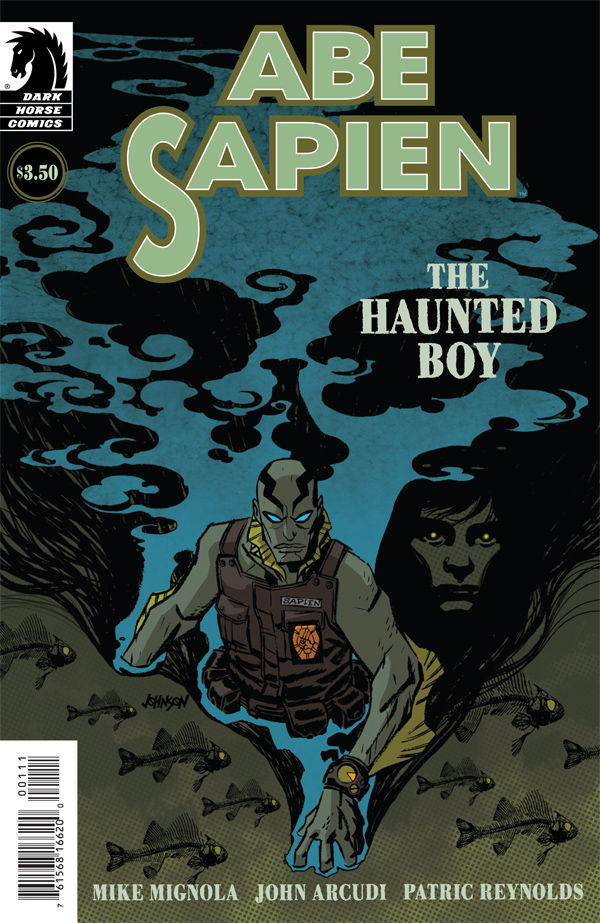
Abe Sapien: The Haunted Boy


Written by Mike Mignola and John Arcudi. Art by Patric Reynolds. Colors by Dave Stewart.
Abe Sapien: The Haunted Boy is a stand-alone story in a series of one-shot issues which Dark Horse is releasing over the coming months. BPRD's famed green hero investigates a haunting following the drowning of a teenage boy, deals with grieving relatives and a sullen witness, and ends up confronting yet another monster taken from European mythology, this time a Scandinavian one.


The artwork of relative newcomer Patric Reynolds is solid, and he does a great job at finely characterising his protagonists through gestures and facial expressions. Abe comes across as more athletic and dynamic than in other BPRD titles. I especially like Reynolds' take on the monster. Which leads me to the criticism I have of the book: the story ends too fast. The set-up is nicely done, but the solution is hurried:  the final confrontation with the monster is all too brief, relies on a coincidence to solve the issue and thus comes across as a bit of an anti-climax. Which is too bad. I guess sometimes it does take more than 24 pages to tell a story well.
Rating: 3.5 out of 5.

Sunday, October 18, 2009

Hellboy: The Wild Hunt #7

When the eight-part story arc The Wild Hunt started, the editors were spreading the word that at the end of it, neither Hellboy nor the world would remain the same. Mike Mignola sends the reader on a wild roller-coaster ride through much of British folklore - past witches searching for a new queen, giants, the Daoine Sidhe and the Wild Hunt itself - straight into the mother of all British legends, the Arthurian saga. Both the witches' new queen and Hellboy's fate (and origin) are directly linked to people and events taken from the stories surrounding the mythical King Arthur. In issue 7, we (and Hellboy) are given titbits of the fate that supposedly awaits Big Red, and in the end he does indeed seem to be on the path leading to that destiny. As so often in Mignola's comics, visions and real events are intertwined in a complicated, dream-like sequence of events which leave much open to interpretation. And indeed, the Hellboy saga moves forward for the first time in many years.

Duncan Fegredo's art is fittingly dark and brooding, and he has now made the Hellboy character his own, drawing him with the same certainty as does Mignola himself. Dave Stewart's colors are as always top notch and so much an integral part of the Hellboy comics.

The backup story, by Mignola, Scott Allie and Patric Reynolds, tells of the a 17th century witch-hunter, Henry Hood (a character introduced in earlier Hellboy stories); a solid short story (as were the backup stories in the previous issues).

Issue #7 confirms The Wild Hunt as an imaginative, brilliantly rendered piece of storytelling; comics at their best.

Rating for the series: 5 of 5.

Tuesday, October 6, 2009

Sir Edward Grey, Witchfinder: In the Service of Angels

Dark Horse's latest Hellboy spin-off is nearing completion, so this seems a good time to review Mike Mignola's latest comics outing. The setting is Victorian London and the hero is one Sir Edward Grey, a character who has had guest appearances in a couple of Hellboy and BPRD stories. The mystery begins with a grisly murder whose victim was a member of an archeological expedition to the Sahara who has discovered the remnants of a Hyperborean city. Later, all the members of the team are picked off one by one by a demon-like creature that the team has inadvertedly brought back with them to London.

The story then continues with Grey's search for the monster which grows more powerful with each killing. Along the way we are treated to a collection of colourful characters, such as a 200-year old Captain lifted from Gulliver's Travels; and a mix of fantastic 19th century myths, such as the Hollow Earth theory which becomes linked to the Hyperborea myth. There are also tie-ins with current BPRD storylines, most notably the grisly frogs which have been at the centre of recent BRP story arcs, as well as the Helioptic Brotherhood of Ra. The latest issue, number 4, introduces Martin Gylfrid, the character at the centre of the recent BPRD storylines.

The story is vintage Mignola then, full of mysteries drawn from all sorts of legends and period literature. The plotting is impeccable, as is Ben Stenbeck's art. In rather simple lines, Stenbeck draws a very moody, very believable Victorian London. Smog-filled streets, overstuffed drawing rooms, a truly menacing East End - highly stereotypical maybe, but well rendered and required to set the scene for readers who know the time period chiefly through movies.

My one regret about the title so far is that the main charctet remains decidedly one-dimensional. We learn about his past exploits, which include saving the queen from witches, earning him the knighthood; we are told that he is in the service of angels and that a dire fate may befall him. But very little of his character is revealed, apart from his penchant for quoting the bible when faced with otherworldly creatures. Unlike other examples of Mignola's creations, this one has no foibles, no character quirks to make him memorable. Not yet, at least. There is a budding romance between Grey and Mary, the medium, which may serve to show a more personal side of him; so there is a chance yet that the writers may rescue Sir Grey from being but a cardboard character. That is the only quibble I find in an otherwise solid, well done and entertaining new series.

Rating (so far): 4 of 5.

Here is a link to an interview with Mike Mignola where he discusses current projects.


(Review updated on 18Oct2009)
Friday, October 2, 2009

Conan the Cimmerian #14: Home for the Hunt

Regular Conan artists Giorello and Villarrubia are taking a couple of months off, so issue 14 was drawn by Joe Kubert und regular writer Timothy Truman. Kubert's art covers the few pages at the beginning and end which feature Conan, while Truman drew the middle part, a story set in Conan's home village. Truman's rough style was used to great effect in a Conan mini-series, Conan and the Songs of the Dead, which was pure horror pulp fiction. Here it is somewhat wasted on a rushed tale of a monster out to kill Conan's mother. I preferred Kubert's few pages which tell the familiar tale of our favourite barbarian finding himself at odds with the dandified behaviour of the rich and noble; even if his style, coupled with the flat colouring used for this issue, comes across as a bit old-fashioned (which is not necessarily a bad thing). Still, this book is only a filler, and coming hot on the heels of the excellent Black Colossus story arc, a bit disappointing.


Issue 15 is also slated to be a one-shot, a fully painted issue written by Tim Truman and illustrated by Paul Lee.

Tuesday, September 22, 2009

Conan the Cimmerian: Black Colossus, by Truman, Giorello and Villarrubia.

When Dark Horse revived the Conan comics franchise a few years ago, they did so to great critical and public acclaim. Having found an artistic team that delivered a faithful yet modern approach to Robert E. Howard's classic tales, they set out to charter, in chronological order, the life and times of the Cimmerian barbarian. Several years down the line, the title was in disarray: both writer Kurt Busiek and colorist Dave Stewart (whose work had done much to create a unique design for Conan), left the title; while Cary Nord's artwork became more and more erratic, vague and cartoony. Dark Horse called on a series of guest writers and artists to fill the gap, and in the end the title felt, in the words of its editor, more like an anthology than an ongoing series. Finally, Dark Horse re-assembled a new team with writer Timothy Truman, artist Tomás Giorello and color artist José Villarrubia and scrapped the old title, gave itself a short break and re-launched the series under the new name Conan the Cimmerian.

Surprisingly, Dark Horse began the new title with a story arc set in Cimmeria which was not directly taken from an REH story, and which featured flashbacks to the adventures of Conan’s grandfather, drawn by guest artist Richard Corben. This was in itself not a bad idea, but it came too early and slowed down the élan of the new series before it properly began. It was not until issue 8 that Conan the Cimmerian finally took off, with the debut of the story arc Black Colossus, based on Howard's short story of the same name. Thus, with the conclusion of the six part story arc in last month’s issue number 13, I feel it is time to review the new title.

The story begins with Conan having moved on from being a thief to embarking on a mercenary career. As the story progresses, Conan moves from becoming a soldier to a captain to the commander of the kingdom of Khoraja's armies, as he marches the troops to thwart the plot of an evil, long-dead sorcerer returned to life, who has come to claim world dominion in the name of his god Seth. The plot involves other typical Conan ingredients such as demons and of course a damsel in distress who needs rescuing and who knows how to show her gratitude to our barbarian – and who happens to be the ruler of a country, thus maybe setting Conan on the path that would lead him eventually to the throne of Aquilonia. The story arc finds its climax in a wonderfully rendered battle between the forces of the undead sorcerer Natohk and Khoraja's amry, before Conan has to venture into the lair of the sorcerer to rescue said damsel in a final show-down between the main protagonists.

Tomás Giorello and colorist José Villarrubia have found a unique visual language, somewhat reminiscent of the art of the title’s first incarnation but yet different, with a slightly unfinished looking, water-colourish feel using muted colours and low on the inks. The artists do a great job of evoking the world of Conan, providing richly detailed, exotic backgrounds and finely differentiated depictions of the various ethnic groups that make up Hyboria. It is here that the title outshines its predecessor: in making Howard’s richly detailed world come truly alive.

Having read the issues back to back, I get the impression that the artistic team is finding its voice as the plot progresses, and with the depiction of the combats in the last two issues, the art truly shines, especially in the dynamic portrayal of the fighting and the greatly detailed epic mass combat scenes reminiscent of old Hollywood movies with their thousands of extras (Cleopatra comes to mind).

The writing, too, seems to improve over the course of the five issues. In the first couple of issues, writer Timothy Truman feels like he has to emulate Howard’s insufferable pseudo-historic, and at times plain silly, dialogue. They are the exception, and become rarer over time, but they really need not be there at all. The plotting is slow over the first couple of issues, which may be in keeping with Howard’s writing, but picks up as soon as Conan marches his troops to face the enemy.

The story’s ending is pure Howard (damsel in distress rescued, a shag for our hero while the rest of the world moves on), but it’s a bit of an anti-climax after the breathtaking telling of the battle. For better or for worse, there are other takes on Howardian clichés: women in various states of undress and insinuations of lesbian relationships between the women in Princess Yasmela’s court. A Conan book probably wouldn’t be complete without these clichés, the question is, whether it’s the better for them. But I guess nobody who reads Howard expects a politically correct story - although it should be pointed out that thankfully Dark Horse leaves out Howard’s stark stereotypical, if not to say racist characterisations of the various non-white races making up Hyboria.

Thus, in summary, it can be said that Black Colossus is a good, exciting and satisfying read, finally establishing Conan the Cimmerian as a title in its own right, and leaving one eager for the next chapters in the life of Conan the Barbarian.

Rating: 4 out of 5.